
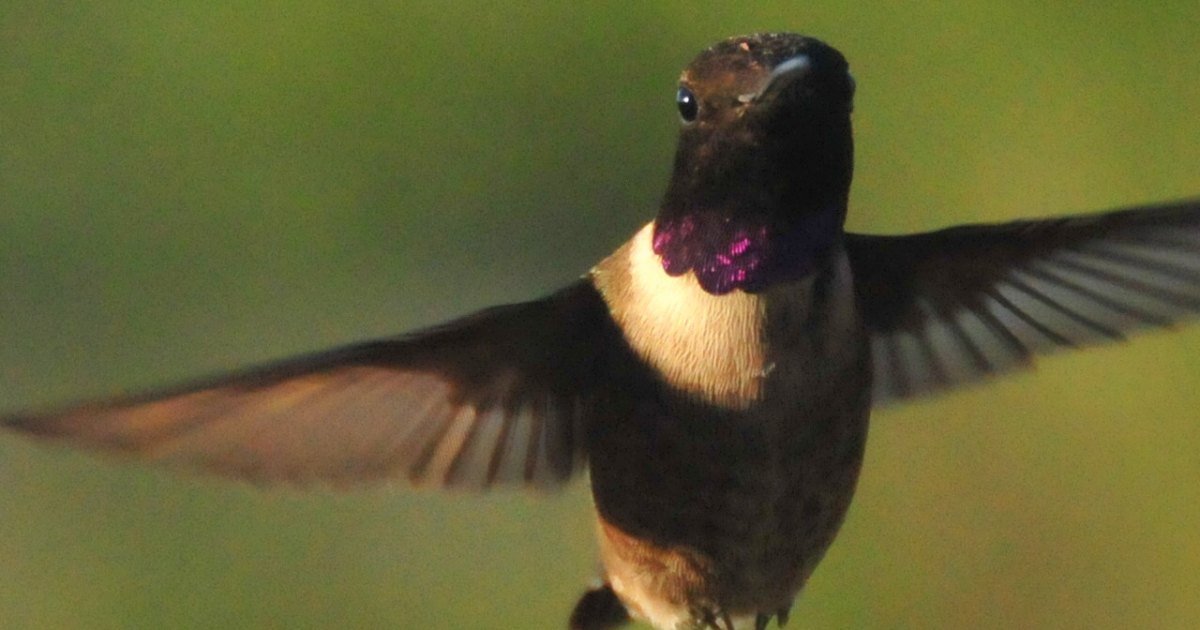
Short answer: on the coast and in East Texas, expect Ruby-throated Hummingbirds by about 15 March. In West and South Texas, Black-chinned Hummingbirds start showing up from early March. In the far south, some hummingbirds never leave at all.
Texas is the hardest state in the country to give one date for, and it is the state most charts get wrong. It is three different situations at once: a wintering ground, a migration highway, and a breeding range for several species.
By region
| Part of Texas | Main species | Typical first arrival | Feeder up by |
|---|---|---|---|
| Coast & East Texas | Ruby-throated | by mid-March | 1 March |
| Central Texas (Hill Country) | Black-chinned, Ruby-throated | early to mid-March | 1 March |
| West Texas & Panhandle | Black-chinned, Broad-tailed, Rufous | from early March | 1 March |
| South Texas / Rio Grande Valley | Buff-bellied and others, some present year-round | present through winter | keep one up all year |
Why Texas is busy twice
Birds that nested far to the north funnel through Texas on their way south in autumn. That is why a feeder here can stay busy for weeks after your own summer regulars have gone — the birds you are seeing in late September are not the birds you had in July.
The same geography works in spring. Ruby-throated Hummingbirds crossing the Gulf of Mexico make landfall on the Texas and Louisiana coast, which is why the coast sees them well before inland areas at the same latitude.
When they leave
Most birds move out between late September and November. In the southern half of the state, and along the coast, some stay through winter — which is the main reason not to take your feeder down on a calendar date here. Rufous and Black-chinned Hummingbirds in particular turn up at Gulf Coast feeders in the dead of winter.
Practical timing
- Hang a clean feeder by 1 March. Males arrive roughly a week ahead of females, and the first bird through is scouting. An empty feeder on that day is a yard he does not come back to.
- One part white sugar to four parts water. No red dye, no honey, nothing else. See the nectar recipe.
- Keep it clean. In warm Texas weather, change the nectar at least twice a week — every other day is better once it gets hot.
- Leave it up about two weeks after your last sighting in fall. The late birds are usually stragglers from further north, not your summer regulars.
What to plant
A feeder is a snack; flowers are the meal. Hummingbirds favour long tubular flowers and show some preference for red, orange and pink, though any flower with plenty of nectar will pull them in. For Texas specifically, your state native plant society and county extension office publish regional lists that will always beat a national one — the right plant in the Hill Country is not the right plant in the Panhandle.
The principle that matters everywhere: plant for a succession of blooms, not one big show in June. Four plants covering the season beat twenty that all flower at once. More on that in native plants that attract hummingbirds, in bloom order.
Keep reading
- Hummingbird arrival dates for every state
- Why hummingbirds stop coming to a feeder
- How to keep ants and wasps off a hummingbird feeder
Sources
- National Audubon Society — When to Expect Hummingbirds at Your Feeders and Flowers This Spring
- Avian Report — regional arrival and departure analysis drawing on Cornell Lab of Ornithology range data, eBird records and banding studies
- Smithsonian’s National Zoo and Conservation Biology Institute — nectar recipe and feeder guidance
Last reviewed: October 2026. These are typical windows, not fixed dates — first sightings shift by a week or more with the weather. We are building the 2027 map from reader reports, so if you see one, tell us the date.